Introduction
Two of India’s most popular government-backed retirement instruments, and yet people constantly mix up which does what. NPS vs PPF — both offer safety and tax benefits, but they work quite differently, and picking the wrong one for your situation can mean leaving money on the table over decades.
The Basic Difference
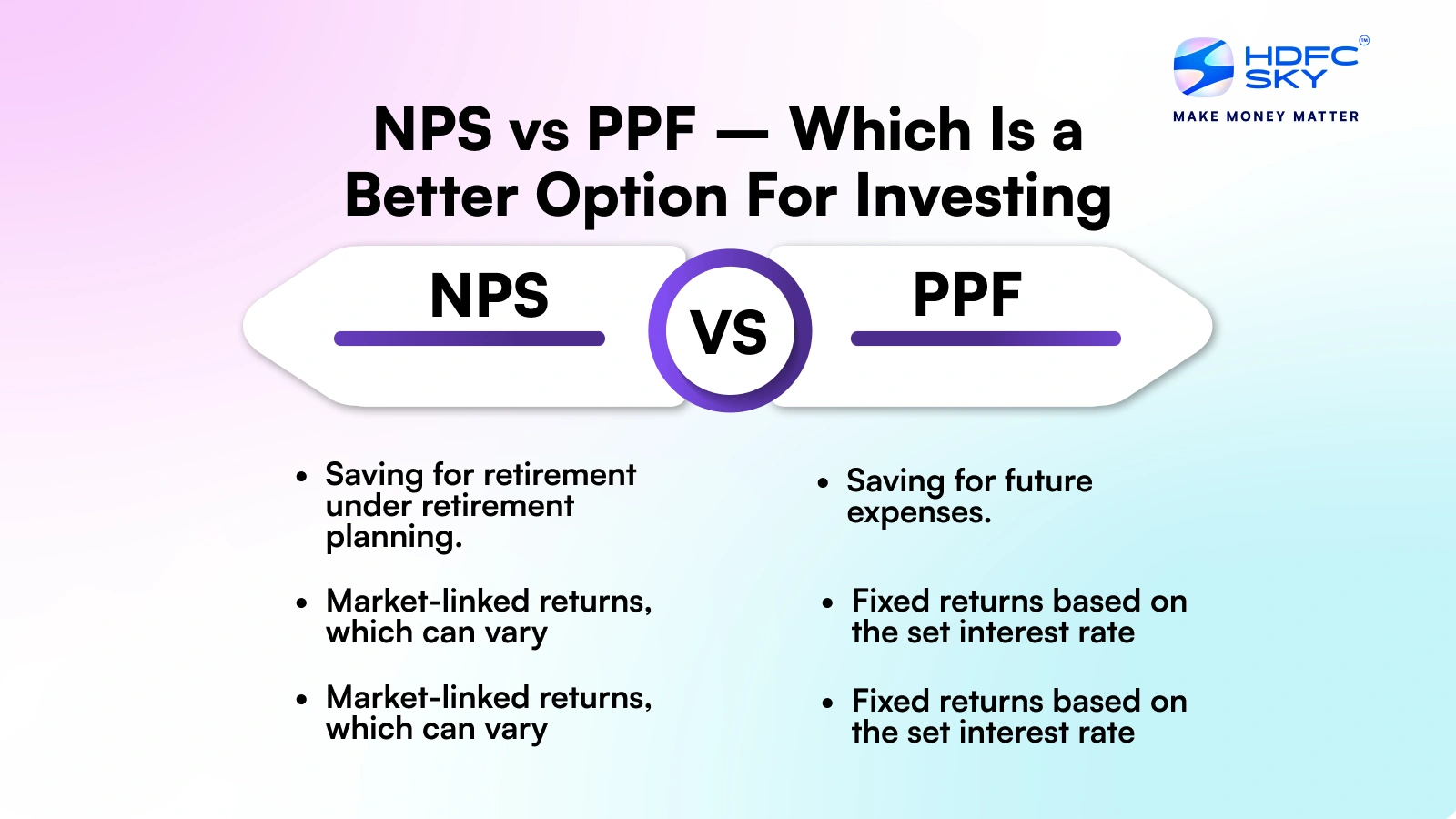
NPS (National Pension System) is a market-linked retirement scheme with a mix of equity and debt exposure, offering potentially higher returns but partial annuitization at maturity, while PPF is a fixed-return, government-guaranteed savings scheme with complete tax-free withdrawal at maturity.
How NPS Works
NPS lets you choose an asset allocation between equity, corporate bonds, and government securities, adjusted based on your risk appetite and age (auto-choice reduces equity exposure as you age). Returns have historically ranged 9-12% depending on your allocation and market performance.
At maturity (age 60), you can withdraw 60% of the corpus tax-free, but the remaining 40% must go into an annuity, which provides you a regular pension but locks up that portion permanently.
How PPF Works
PPF is refreshingly simple — a 15-year fixed-return instrument, currently offering around 7.1% (revised quarterly by the government), with the entire maturity amount, including interest, completely tax-free. No forced annuitization, no market risk, no complications at withdrawal.
I’ve noticed people who value simplicity and complete control over their money at maturity often prefer PPF, even knowing NPS’s potential returns are typically higher over the long run.
Tax Benefits Comparison
- PPF: Contributions qualify under Section 80C (up to ₹1.5 lakh), and the entire maturity is tax-free (EEE status)
- NPS: Contributions qualify under Section 80C AND an additional ₹50,000 under Section 80CCD(1B), making total deduction potential higher than PPF alone
NPS offers an additional ₹50,000 tax deduction beyond the standard Section 80C limit, making it particularly attractive for those in higher tax brackets looking to maximize deductions.
Return Potential Over the Long Term
Picture two people investing ₹1.5 lakh annually for 25 years — one in PPF at a steady 7.1%, another in NPS with a moderate equity allocation averaging 10%. The NPS investor’s corpus could end up considerably larger, purely due to the higher average return compounding over 25 years, though with more volatility along the way.
[link to related guide on NPS asset allocation strategies here]
Liquidity and Flexibility
PPF allows partial withdrawals from the 7th year onward, and loans against the balance from the 3rd year. NPS has much stricter withdrawal rules, generally locked until age 60 except for specific circumstances like critical illness or specific life events, with partial withdrawal limited to 25% of your own contributions.
Which Should You Choose
For someone wanting simplicity, guaranteed returns, and full control at maturity, PPF remains a solid, stress-free choice. For someone comfortable with market-linked returns and wanting to maximize tax deductions while accepting some equity exposure and annuitization requirements, NPS often builds a larger retirement corpus over the long run.
Many financial planners actually recommend using both — PPF for the safe, guaranteed portion of your retirement portfolio, and NPS for the growth-oriented, higher-return portion.
FAQs
Can I invest in both NPS and PPF simultaneously? Yes, and many people do exactly this to balance safety with growth potential in their retirement portfolio.
Is NPS riskier than PPF? Yes, since NPS has equity exposure and market-linked returns, while PPF offers fixed, government-guaranteed returns with zero market risk.
What happens to NPS if I switch jobs? NPS is fully portable across employers and even between salaried and self-employed status, unlike some employer-linked retirement schemes.
Can I withdraw my entire NPS corpus at 60? No, only 60% can be withdrawn tax-free; the remaining 40% must be used to purchase an annuity for regular pension income.
Is PPF interest rate fixed for the entire 15 years? No, the government revises the PPF interest rate quarterly, though it tends to remain relatively stable compared to market-linked instruments.
Conclusion
Deciding between NPS vs PPF doesn’t have to be either-or — each serves a different purpose in a well-rounded retirement plan. If you want simplicity and guaranteed safety, PPF delivers reliably. If you’re comfortable with some market exposure for potentially higher growth and extra tax benefits, NPS is worth including too. Combining both often gives you the best of stability and growth for your retirement years.