Introduction
You place a buy order on your trading app, and suddenly there’s a choice — intraday or delivery. Pick wrong and you might end up in a trade you didn’t intend to hold, or worse, get auto-squared-off at a loss. Understanding intraday vs delivery trading properly before you click “buy” can save you real money and unnecessary stress.
The Core Difference
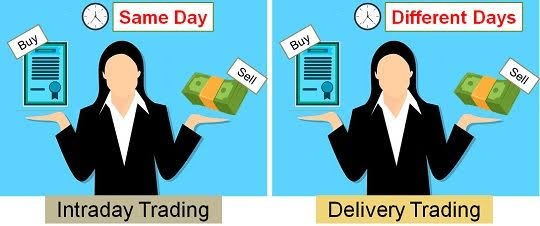
Intraday trading means buying and selling a stock on the same trading day, using leverage but requiring you to close the position before market close, while delivery trading means buying shares to hold in your demat account for any duration you choose.
How Intraday Trading Works
With intraday, brokers typically offer leverage — meaning you can trade with more money than you actually have, sometimes 4-5x your capital. The catch: your position must be closed before markets close at 3:30 PM, or the broker auto-squares it off, sometimes at an unfavorable price.
I’ve noticed new traders get drawn to intraday because of the leverage — bigger position, bigger potential profit. But that leverage cuts both ways, and losses can pile up just as fast.
How Delivery Trading Works
Delivery trading is simpler — you buy shares, they land in your demat account, and you hold them for as long as you want, whether that’s a week or ten years. No leverage, no forced closing time, no daily pressure.
Picture buying 10 shares of a company you believe in for the long run, then simply forgetting about them for two years while they compound — that’s delivery trading in its purest form.
Capital Requirements
Intraday requires less capital upfront due to leverage — you might control ₹50,000 worth of stock with just ₹10,000. Delivery requires the full amount since there’s no leverage; you pay for exactly what you buy.
Risk Comparison
- Intraday: Higher risk due to leverage, time pressure, and market volatility within a single day
- Delivery: Lower immediate risk, but still exposed to broader market and company-specific risk over time
Because intraday trading uses leverage and forces same-day closure, losses can amplify quickly — making it significantly riskier for beginners compared to delivery trading.
Brokerage and Charges
Intraday trades typically attract lower brokerage (often flat ₹20 or 0.03%, whichever is lower) but you’re paying it twice — once buying, once selling, same day. Delivery trades sometimes have zero brokerage on the buy side with select brokers, though this varies.
[link to related guide on brokerage charges comparison across Indian brokers here]
Who Should Choose What
If you’re new to the markets, delivery trading is genuinely the safer starting point. It removes time pressure and lets you learn stock behavior without the added stress of leverage and same-day decisions. Intraday suits experienced traders who understand technical analysis and can monitor markets actively during trading hours.
FAQs
Can I convert an intraday trade to delivery if I don’t sell in time? Some brokers allow this conversion before market close, but it requires having full funds available; otherwise, the broker auto-squares it off.
Is intraday trading more profitable than delivery? Not necessarily — it can generate quicker gains but also quicker losses. Long-term delivery investing has historically built more sustainable wealth for most retail investors.
Do I need more capital for intraday trading? No, actually less due to leverage, though this increases your risk exposure per rupee invested.
Is delivery trading better for beginners? Generally yes, since it removes the time pressure and leverage risk that trips up most new intraday traders.
Are taxes different for intraday and delivery trading? Yes — intraday gains are taxed as speculative business income, while delivery trading gains fall under capital gains tax (short or long-term depending on holding period).
Conclusion
Choosing between intraday vs delivery trading really comes down to your risk appetite, time availability, and experience level. If you can’t watch the market actively through the day, intraday probably isn’t for you — and that’s completely fine. Delivery trading, held with patience, has built more wealth for ordinary investors than most flashy day-trading strategies ever will.